
Reading the dial.
A chronograph dial looks busy, but each element has one job. On most watches the large central seconds hand belongs to the chronograph and sits at zero until you start it. The watch’s ordinary running seconds move on a small sub-dial instead.
- Central chronograph hand: elapsed seconds.
- Minute counter: a sub-dial, often 30 minutes.
- Hour counter: a sub-dial, often 12 hours, on some models.
- Running seconds: a sub-dial showing the watch is working, independent of the chronograph.
How to use it.
- Press the top pusher (usually at 2 o’clock) to start timing.
- Press it again to stop. Press it again to restart from where it stopped, if you want to add time.
- When stopped, press the bottom pusher (usually at 4 o’clock) to reset all chronograph hands to zero.
- If a hand does not return exactly to zero after a reset, check your manual; many quartz chronographs have a hand-alignment procedure.
The tachymeter scale.
A tachymeter is the scale printed around the bezel or the dial edge. Start the chronograph as you pass one marker, stop it one unit of distance later (a kilometre or a mile), and read the number the seconds hand points to: that is your average speed in units per hour. The scale is simply 3,600 divided by the elapsed seconds, so it works for anything measured per hour, such as items produced or laps completed.
A tachymeter only works for events lasting under 60 seconds on most dials, because the scale covers one sweep of the seconds hand.
Mechanical, mecha-quartz and quartz chronographs.
Can you get one wet?
Do not press chronograph pushers underwater unless the watch is specifically rated for it or the pushers screw down. Pressing them lets water past the seals. Water resistance explained.
Which should you choose?
If you love the look and want easy ownership, a mecha-quartz or quartz chronograph delivers the style for less. If the mechanism itself is the point, save for a mechanical one. Ferro AGL 2 automatic vs chronograph.
Chronographs we recommend.
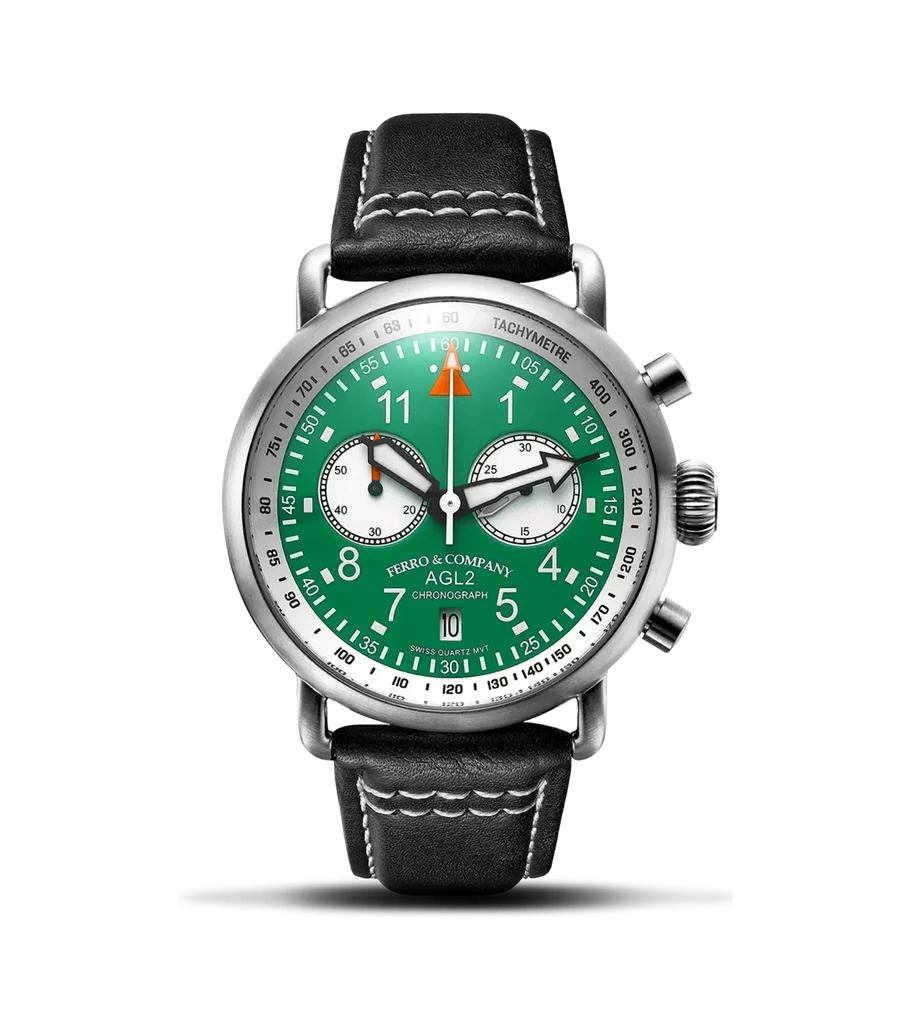
AGL 2 Chronograph Green
A vintage aviation chronograph with a clean green dial and practical quartz timing
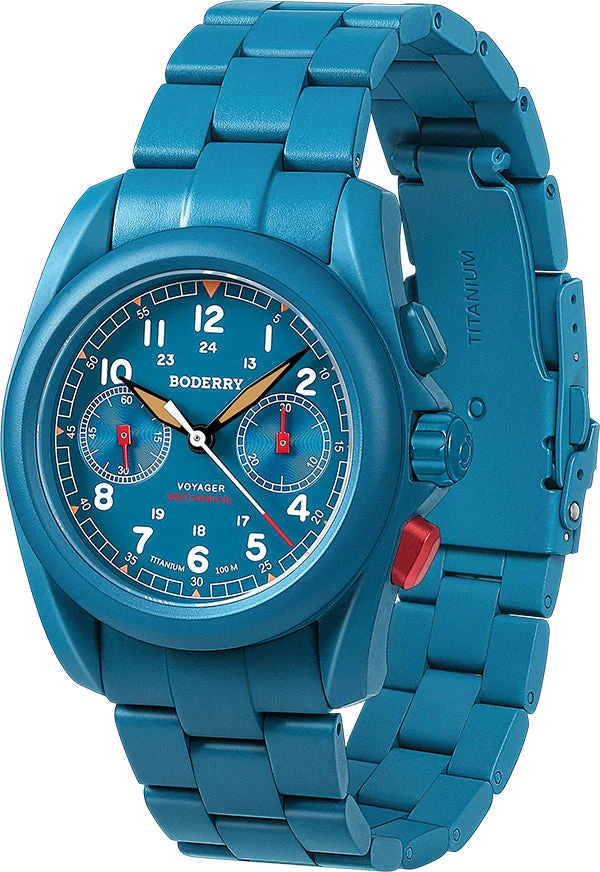
Voyager Chronograph Cerulean Blue / Titanium Bracelet
A hand-wound mechanical chronograph in unmistakable blue titanium.
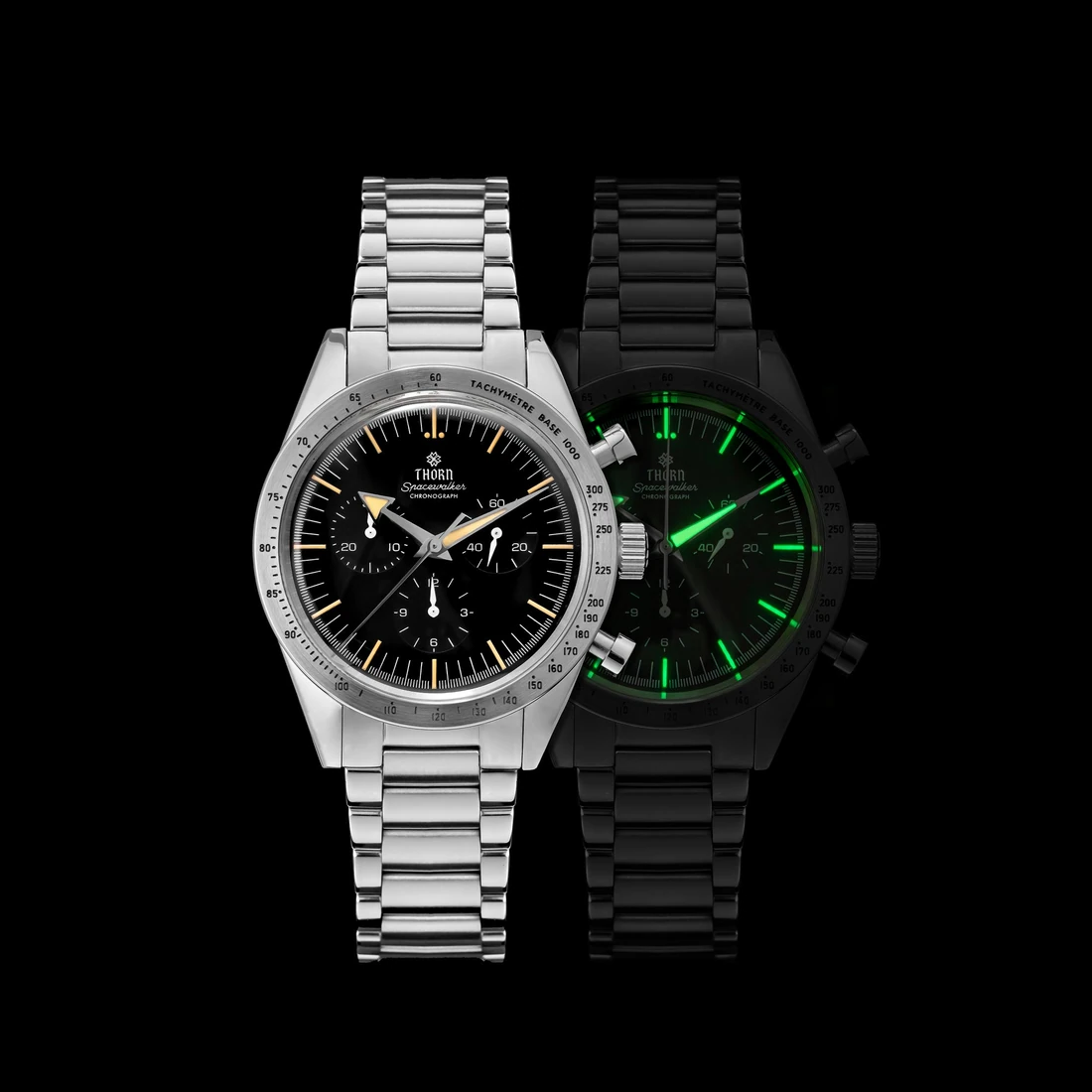
T026C-R5030D Chronograph
A real quartz chronograph in a compact racing case.
A few good questions.
How do I reset a chronograph watch?
Stop the chronograph with the top pusher, then press the bottom pusher. The bottom pusher only resets while the chronograph is stopped on most watches.
Does running the chronograph drain the battery or reserve?
On a quartz chronograph it uses extra battery power, so leaving it running shortens battery life. On a mechanical chronograph it uses some extra energy from the mainspring.
What is a tachymeter used for?
Measuring speed over a known distance. Time one kilometre or mile with the chronograph and read the average speed in units per hour from the scale.
What is a mecha-quartz chronograph?
A quartz watch with a mechanical chronograph module, giving crisp pushers and an instant snap-back reset at a lower price than a mechanical chronograph.
How we write guides: we explain watchmaking from manufacturer documentation and published standards, and say plainly where numbers vary by brand or movement. Our approach.